
- 0
- 1,779 word
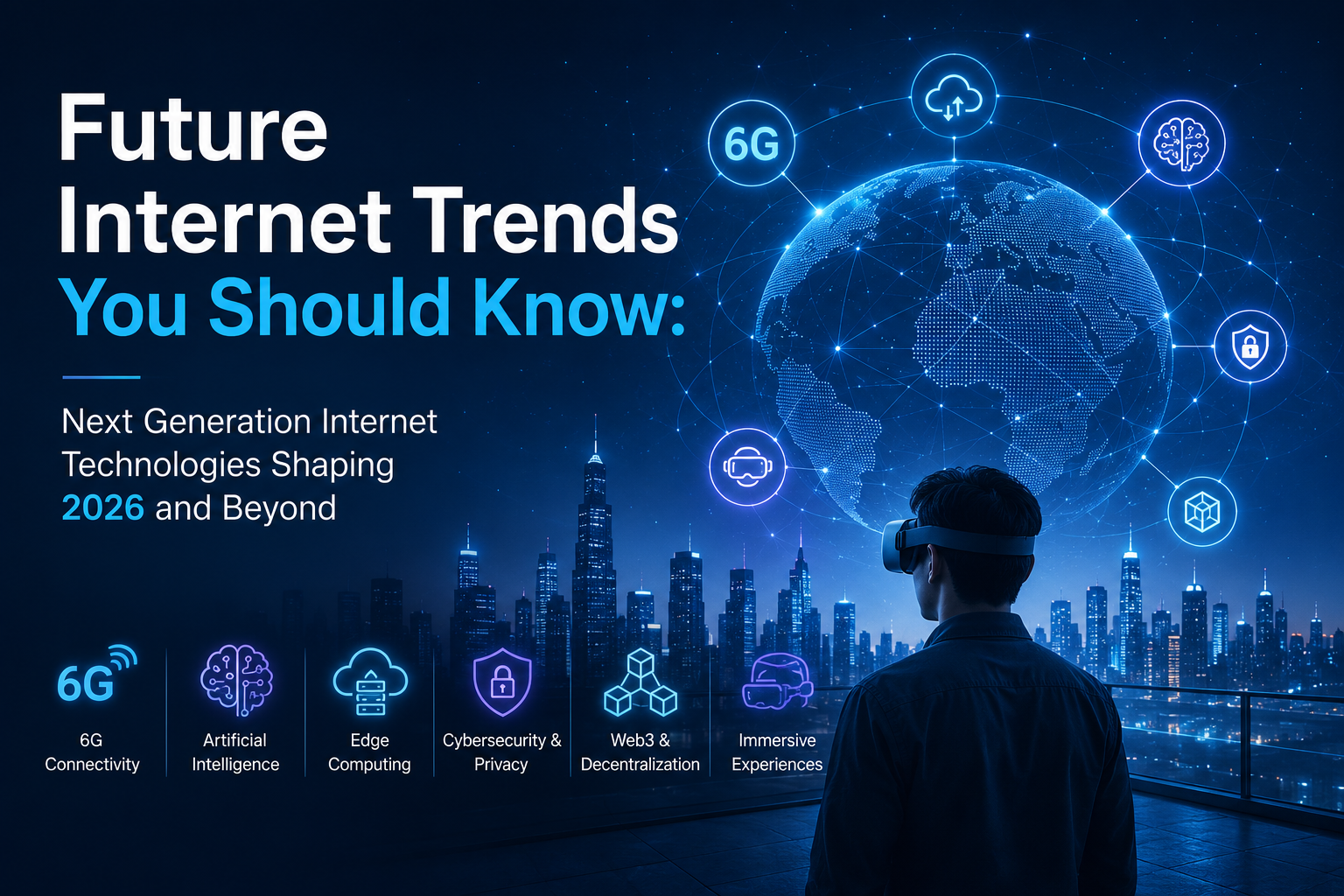
Over the last 15 years, I have witnessed some of the most remarkable transformations in digital history. When I first started analyzing internet technology trends, social media platforms were still evolving, smartphones were becoming mainstream, and cloud computing was only beginning to reshape business operations.
Today, the internet is no longer just a collection of websites connected through networks. It has evolved into a complex digital ecosystem powered by artificial intelligence, cloud infrastructure, edge computing, blockchain, and billions of connected devices.
Understanding future internet trends is no longer optional. Businesses, entrepreneurs, developers, marketers, and even everyday users must stay informed to remain competitive in a rapidly changing digital world.
One lesson I have learned from observing internet technology trends over the years is that innovation rarely moves in a straight line. Some technologies exceed expectations, while others disappear despite enormous hype. However, one thing remains clear: the next generation internet will dramatically redefine how we work, communicate, shop, learn, and interact online.
Understanding Future Internet Trends
What Is the Next Generation Internet?
The next generation internet refers to an intelligent, decentralized, highly connected digital environment that integrates AI, automation, ultra-fast networks, immersive technologies, and advanced security frameworks.
Unlike today’s internet, which often relies on centralized platforms, future web technologies aim to provide greater personalization, efficiency, transparency, and user control.
Why Internet Technology Trends Are Accelerating
Innovation cycles have become significantly shorter.
Fifteen years ago, major internet changes often took years to achieve mass adoption. Today, AI tools, cloud services, and software platforms can gain millions of users within months.
Several factors contribute to this acceleration:
- Increased computing power
- Global cloud infrastructure
- Open-source development
- AI-driven automation
- High-speed connectivity
Key Drivers of Internet Innovation
Artificial Intelligence
AI is becoming the operating system of the internet. From intelligent recommendations to predictive search results, AI influences nearly every online interaction.
Cloud Computing
Cloud platforms enable businesses to scale globally without maintaining expensive physical infrastructure.
Edge Computing
Edge computing processes data closer to users, reducing latency and improving performance.
Internet of Things (IoT)
Connected devices generate massive volumes of real-time data that fuel smarter applications.
High-Speed Connectivity
5G and future 6G networks enable faster communication between devices, applications, and cloud systems.
Artificial Intelligence Will Transform the Internet
Among all future internet trends, AI may have the greatest long-term impact.
Over the last few years, I have observed a dramatic shift from search-driven experiences to AI-assisted experiences. Users increasingly expect systems to understand intent rather than simply respond to keywords.
AI-Powered Search Engines
Search is evolving from link discovery to answer generation.
Instead of displaying pages of results, AI-powered search systems increasingly provide contextual answers, summaries, and recommendations.
Personalized User Experiences
Future web technologies will create highly personalized digital journeys.
Websites will dynamically adapt content, products, interfaces, and recommendations based on user behavior and preferences.
AI Content Creation
AI-generated content, images, videos, and software code are becoming mainstream.
Businesses that combine human expertise with AI-assisted workflows will gain significant competitive advantages.
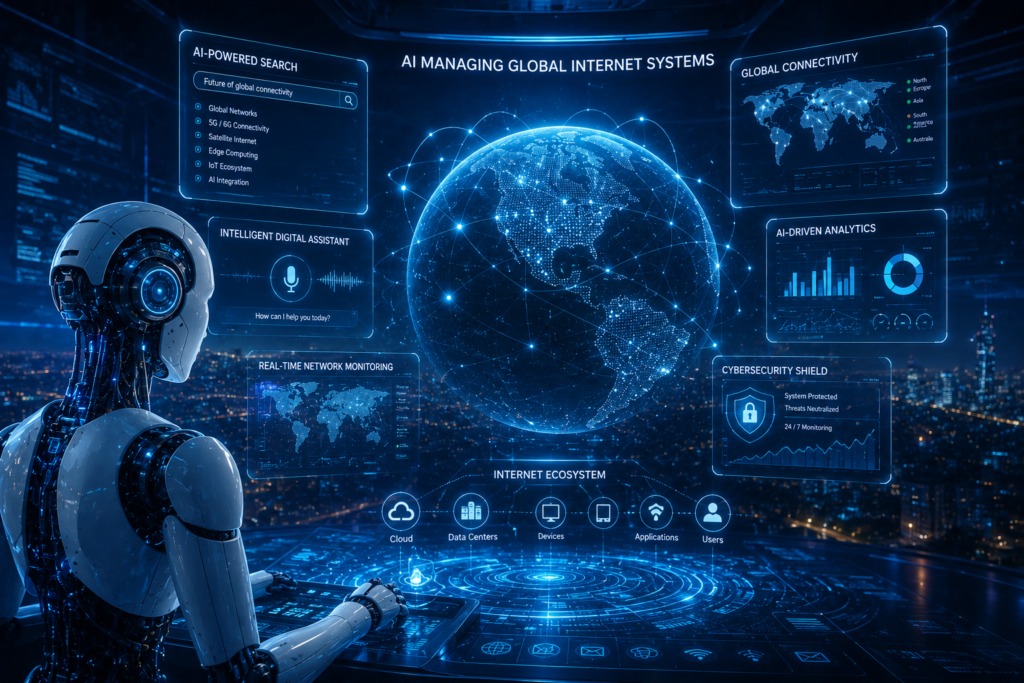
Intelligent Digital Assistants
Future digital assistants will evolve far beyond chatbots.
They will manage schedules, conduct research, negotiate transactions, automate workflows, and serve as personal digital agents.
One trend I consistently observe is that users increasingly value convenience over complexity. AI will become the invisible layer that powers most online interactions.
Future Web Technologies Reshaping Online Experiences
Progressive Web Apps (PWAs)
PWAs deliver app-like experiences directly through browsers without requiring downloads.
They offer faster performance, offline access, and improved user engagement.
Serverless Architecture
Serverless computing allows developers to focus on application logic rather than server management.
This model reduces costs while improving scalability.
Edge Computing
As digital experiences become more real-time, edge computing will become essential.
Applications such as autonomous vehicles, online gaming, and industrial automation require ultra-low latency.
WebAssembly
WebAssembly enables near-native performance within web browsers.
This technology allows advanced software, games, and productivity applications to run directly on the web.
Real-Time Web Applications
Collaboration platforms, streaming services, and communication tools increasingly rely on real-time functionality.
The future internet will emphasize instant interaction and continuous synchronization.
The Rise of the Decentralized Internet
Web3 Technologies
Web3 aims to reduce reliance on centralized platforms by distributing ownership and control.
Blockchain-Based Applications
Blockchain enables transparent and secure digital transactions.
Applications include digital identity, supply chain tracking, decentralized finance, and smart contracts.
Decentralized Identity
Users may eventually control their own digital identities without relying on major technology providers.
User Data Ownership
One of the most important future internet trends involves giving users greater ownership of their personal information.
However, decentralization also faces challenges:
- Scalability limitations
- Regulatory uncertainty
- User experience barriers
- Security concerns
Based on years of industry observation, I believe decentralization will complement—not replace—centralized systems.
Internet Trends 2026 and Beyond
5G and 6G Connectivity
While 5G adoption continues to expand, researchers are already developing 6G technologies.
These networks promise dramatically faster speeds, lower latency, and intelligent network management.
AI-Driven Networks
Future network infrastructure will automatically optimize performance, security, and resource allocation using AI.
Smart Cities Integration
Connected infrastructure will improve transportation, energy management, public safety, and environmental monitoring.
Immersive Digital Experiences
Augmented reality, virtual reality, and mixed reality will become increasingly integrated into everyday internet usage.
Digital Twins
Digital twins create virtual representations of physical environments, systems, and assets.
Industries ranging from manufacturing to healthcare are already exploring their potential.
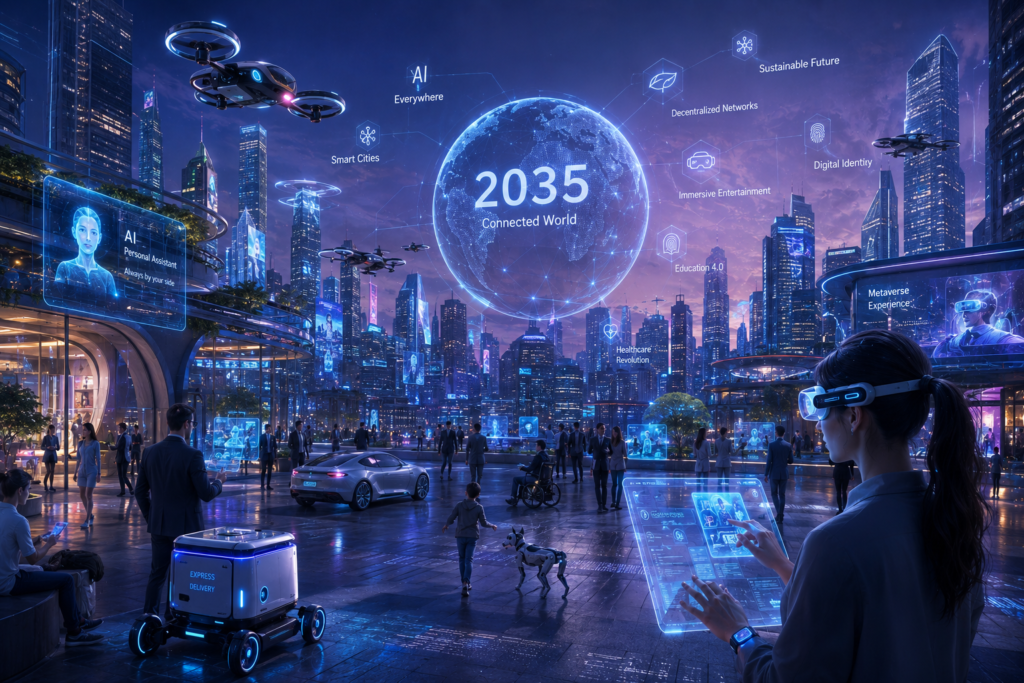
The internet trends 2026 landscape will be defined by seamless integration between physical and digital environments.
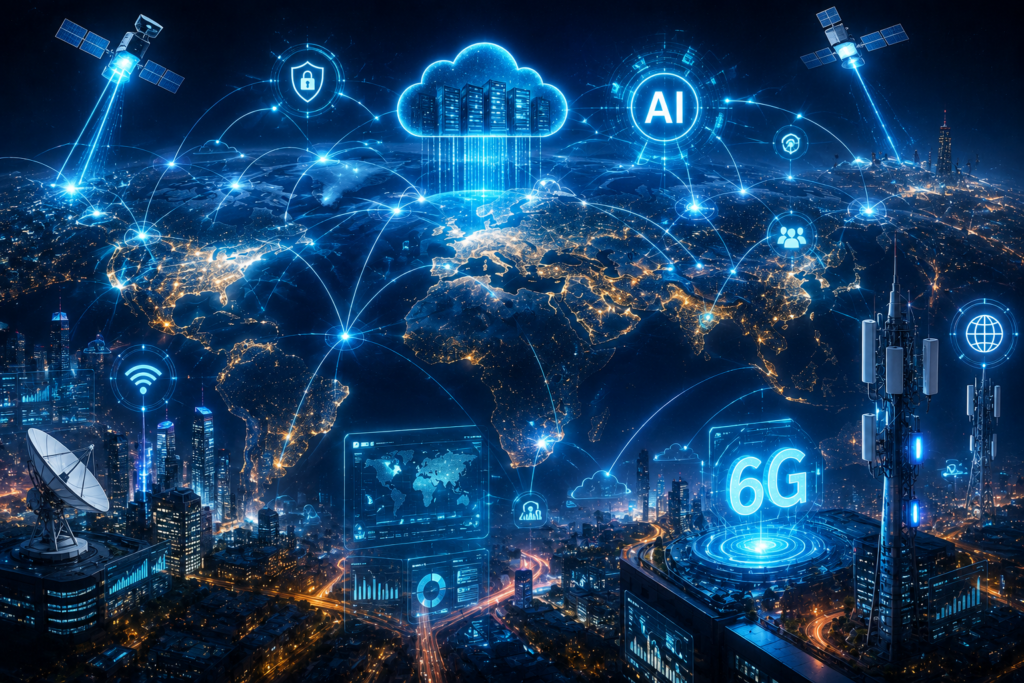
[IMAGE PLACEHOLDER #3]
Image Prompt:
“Next generation internet powered by 6G networks, smart cities, AI systems, connected devices, futuristic digital ecosystem, ultra realistic, highly detailed”
Extended Reality and the Future Internet
AR Experiences
Augmented reality overlays digital information onto physical environments.
Retailers, educators, and healthcare providers are actively investing in AR solutions.
VR-Based Web Platforms
Virtual reality environments offer immersive collaboration, entertainment, and learning experiences.
Mixed Reality Workspaces
Future workplaces may combine physical and digital elements to enhance productivity and collaboration.
The Evolution of Digital Interaction
The next generation internet will likely move beyond screens toward immersive environments where users interact naturally through voice, gestures, and spatial computing.
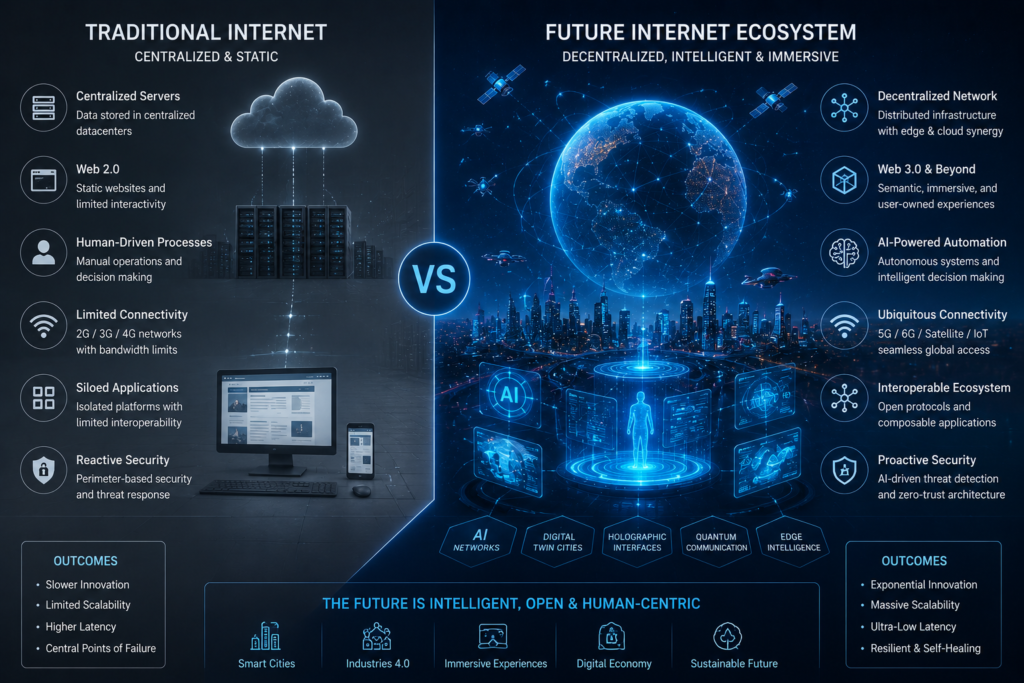
Comparison Table – Today’s Internet vs Next Generation Internet
| Feature | Today’s Internet | Next Generation Internet |
|---|---|---|
| Speed | Moderate to high | Ultra-fast 5G/6G connectivity |
| Security | Reactive security systems | AI-driven predictive security |
| AI Integration | Limited assistance | Deep integration across platforms |
| Personalization | Rule-based recommendations | Real-time adaptive experiences |
| Connectivity | Human-centered | Human and machine connectivity |
| User Experience | Screen-focused | Immersive and intelligent |
| Data Ownership | Platform-controlled | User-controlled identity models |
| Scalability | Cloud-dependent | Cloud plus edge computing architecture |
Cybersecurity Challenges in the Future Internet
AI-Powered Threats
Cybercriminals increasingly leverage AI to automate attacks and identify vulnerabilities.
Quantum Computing Risks
Quantum computers could eventually challenge existing encryption methods.
Privacy Concerns
As digital ecosystems become more interconnected, privacy management becomes increasingly complex.
Data Protection Strategies
Organizations should prioritize:
- Zero-trust architecture
- AI-powered threat detection
- Encryption modernization
- Security awareness training
- Continuous monitoring
Cybersecurity will remain one of the most important internet technology trends throughout the coming decade.
Industries That Will Benefit Most
E-Commerce
AI personalization and immersive shopping experiences will transform online retail.
Education
Interactive learning platforms, virtual classrooms, and AI tutors will improve accessibility and engagement.
Healthcare
Connected devices, predictive analytics, and telemedicine will enhance patient outcomes.
Financial Services
AI-driven fraud detection and blockchain-based transactions will improve efficiency and security.
Software Development
Automation tools will accelerate coding, testing, deployment, and maintenance processes.
Entertainment
Streaming platforms, gaming ecosystems, and immersive media experiences will continue evolving rapidly.
Smart Manufacturing
Industrial IoT and digital twins will optimize production and supply chain operations.
My Perspective After 15 Years Following Internet Technology Trends
Looking back, several breakthroughs stand out.
Cloud computing exceeded my expectations. Many organizations initially resisted cloud adoption, yet today it powers much of the global digital economy.
Mobile technology transformed user behavior faster than most analysts predicted. Businesses that embraced mobile-first strategies thrived, while others struggled to catch up.
Artificial intelligence may ultimately surpass both cloud and mobile computing in terms of impact.
I have also witnessed failures. Some early virtual worlds, proprietary ecosystems, and heavily centralized platforms promised revolutionary change but failed because they lacked practical value or user adoption.
The biggest lesson? Technology succeeds when it solves real problems.
Businesses preparing for the future internet should focus less on hype and more on adaptability, experimentation, and continuous learning.
Final Thoughts
The most important future internet trends are converging simultaneously. Artificial intelligence, future web technologies, edge computing, decentralized systems, immersive experiences, and high-speed connectivity are reshaping the digital landscape.
The opportunities are enormous, but so are the challenges. Organizations must address cybersecurity, privacy, ethics, and digital inclusion while embracing innovation.
For businesses, the next generation internet is not a distant concept it is already emerging today. Companies that invest in digital transformation, AI adoption, cloud infrastructure, and workforce education will be better positioned to succeed.
As someone who has spent more than 15 years tracking internet technology trends, I believe the coming decade will produce changes even more significant than the mobile revolution. The future belongs to organizations and individuals willing to adapt, experiment, and continuously evolve alongside technology.
FAQ Section
What are the most important future internet trends?
The most important future internet trends include AI-powered platforms, edge computing, Web3 technologies, immersive experiences, 6G connectivity, digital twins, and intelligent cybersecurity systems.
What is the next generation internet?
The next generation internet is an AI-driven, highly connected, decentralized digital ecosystem that delivers faster, smarter, and more personalized online experiences.
How will AI change the internet?
AI will transform search, content creation, personalization, automation, cybersecurity, customer service, and digital interactions across virtually every online platform.
Which future web technologies will dominate by 2030?
Progressive Web Apps, edge computing, WebAssembly, serverless architecture, AI-powered platforms, and decentralized identity systems are expected to dominate by 2030.
What are the biggest internet technology trends businesses should watch?
Businesses should monitor AI adoption, cybersecurity innovation, cloud infrastructure, edge computing, immersive technologies, decentralized systems, and high-speed connectivity developments.
Author

razamohd1203@gmail.com
Related Posts
Space Technology in 2026: How Future Space Technology is Transforming Exploration and Innovation
- 0
- 1,598 word
Fifteen years ago, when I first began closely following the aerospace sector, space missions were largely dominated by government agencies, long development...
Future of Robotics in Daily Life: How Personal Robots Will Transform Homes and Society
- 0
- 1,859 word
The future of robotics is no longer a distant concept discussed only in research laboratories or science fiction movies. It is becoming...
AR vs VR: What’s the Difference Between Augmented Reality and Virtual Reality in 2026?
- 1
- 1,733 word
Imagine trying on a new pair of sunglasses without visiting a store or stepping inside a virtual classroom where you can walk...