
- 0
- 1,598 word
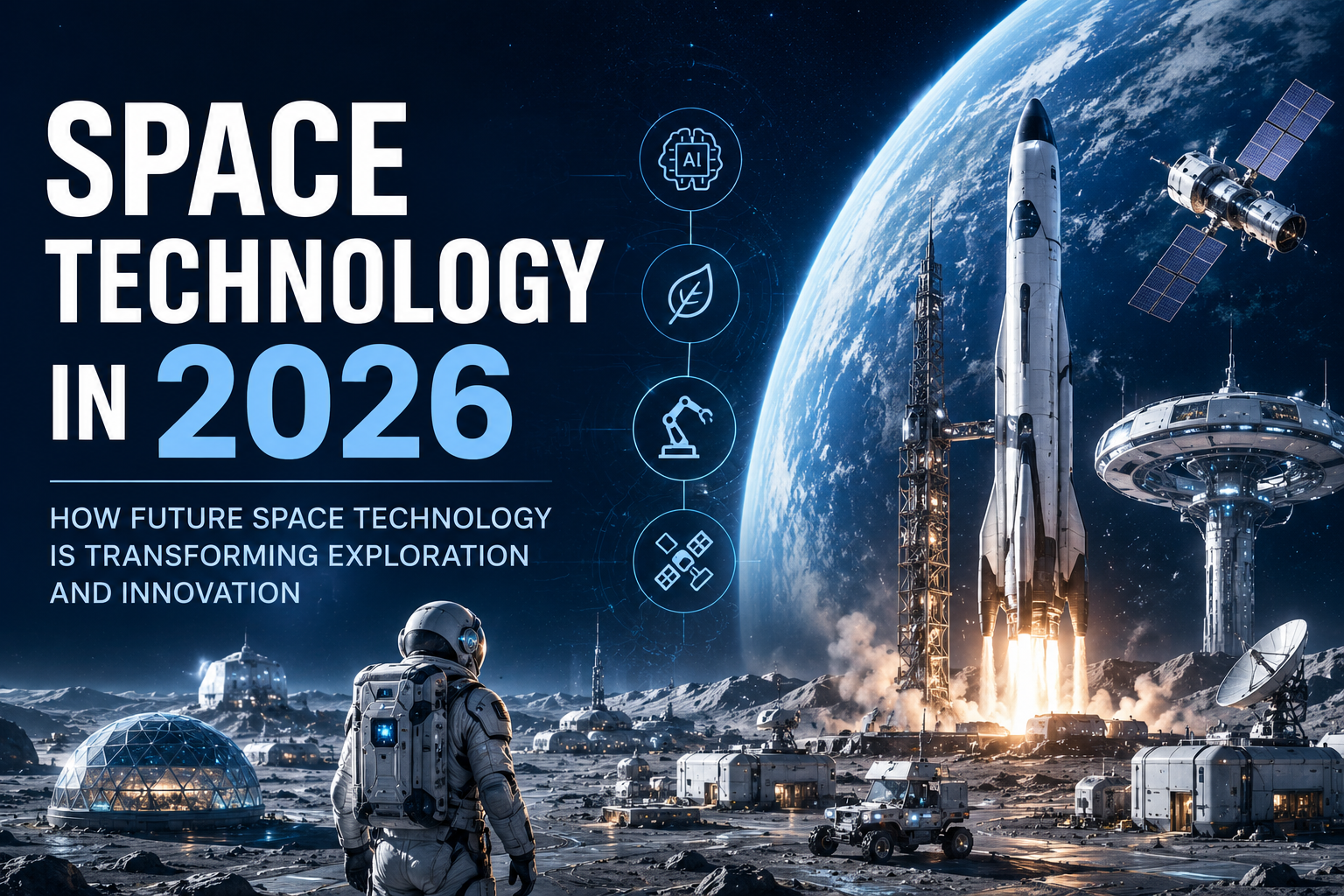
Fifteen years ago, when I first began closely following the aerospace sector, space missions were largely dominated by government agencies, long development cycles, and billion-dollar budgets. Today, the landscape looks dramatically different.
Modern space technology is evolving at a pace that would have seemed impossible a decade ago. Reusable rockets launch and land routinely. Thousands of satellites form global communication networks. Artificial intelligence assists spacecraft operations. Private companies compete alongside national space agencies to push the boundaries of exploration.
What makes today’s transformation particularly fascinating is that space technology is no longer confined to astronauts and scientists. It now influences banking, logistics, agriculture, climate research, telecommunications, transportation, and national security.
Having observed the industry’s evolution for more than 15 years, I believe we are entering the most significant era in the history of space exploration technology. The combination of commercial investment, AI, robotics, advanced materials, and reduced launch costs is accelerating innovation at an unprecedented scale.
The result is a future where latest space innovations will affect almost every aspect of daily life.
Why Space Technology is Advancing Faster Than Ever
Private Space Companies
One of the biggest catalysts behind modern space technology is the rise of commercial aerospace companies.
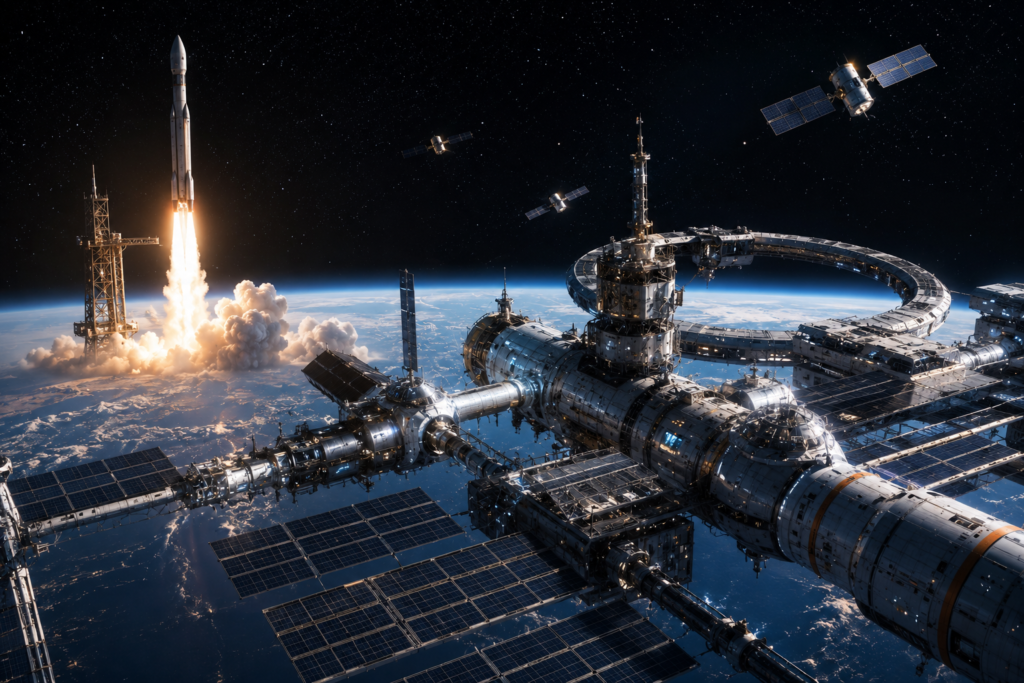
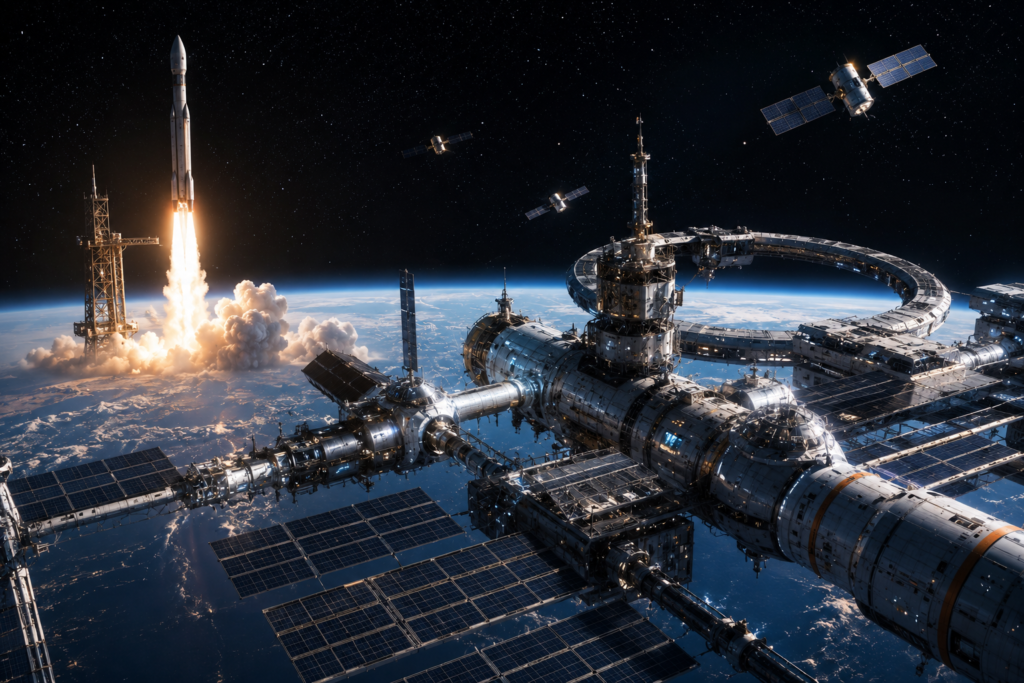
Organizations such as SpaceX and Blue Origin have transformed launch economics through reusable rocket systems. What once required years of preparation can now occur with increasing frequency and lower costs.
The commercialization of launch services has opened opportunities for startups, universities, research institutions, and emerging space nations.
Government Space Programs
Government agencies remain essential drivers of space exploration technology.
Organizations like NASA and European Space Agency (ESA) continue investing heavily in lunar exploration, deep-space missions, Earth observation, and advanced scientific research.
Programs under the Artemis initiative are focused on establishing long-term lunar capabilities and infrastructure that could eventually support missions to Mars. NASA’s lunar surface technology roadmap includes power systems, resource extraction, autonomous robotics, and sustainable Moon-base development. (NASA)
Artificial Intelligence in Space Missions
AI is becoming one of the most influential forces in future space technology.
Modern spacecraft increasingly rely on machine learning for:
- Navigation
- Fault detection
- Resource management
- Autonomous decision-making
- Satellite constellation operations
Research shows AI can significantly improve satellite routing, resource allocation, and mission efficiency. (arXiv)
Latest Space Innovations Reshaping the Industry
Reusable Rockets
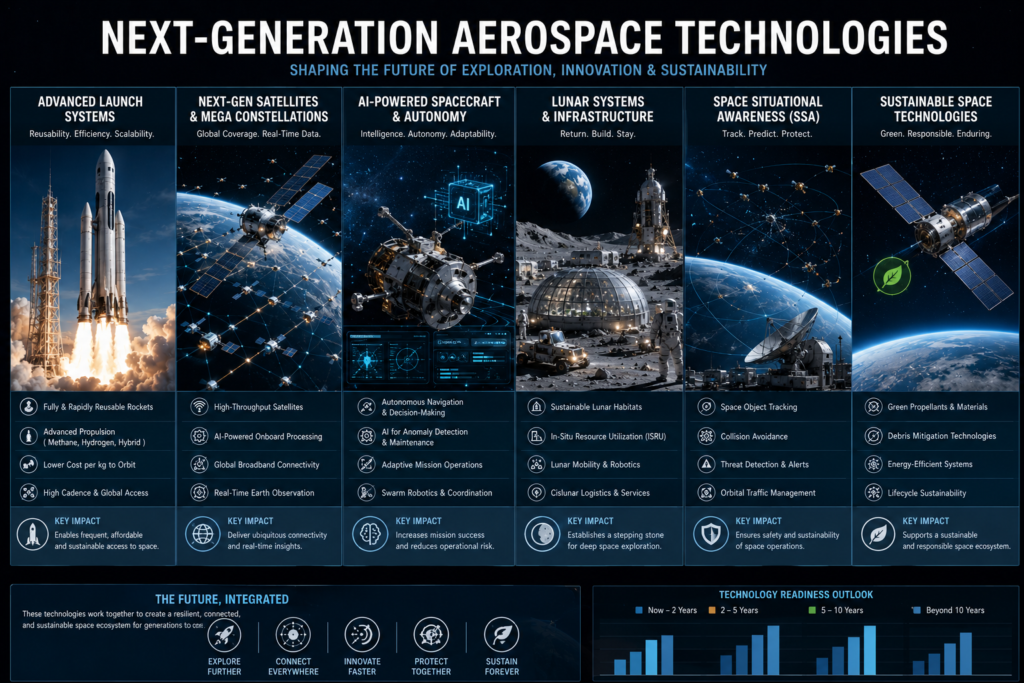
Reusable launch systems represent one of the most important latest space innovations of the modern era.
The ability to recover and relaunch rocket boosters has dramatically reduced launch costs and increased mission frequency. Industry analysts increasingly view reusable rockets as the foundation of the next-generation space economy. (Scientific American)
Satellite Mega-Constellations
Large satellite constellations are changing global communications.
Thousands of interconnected satellites now provide:
- Broadband internet
- Navigation services
- Weather monitoring
- Earth observation
- Defense communications
This segment has become a major driver of commercial space technology investment.
Space-Based Internet
Reliable internet access is expanding into regions that previously lacked connectivity.
Satellite internet systems are creating new opportunities for:
- Remote education
- Telemedicine
- Rural businesses
- Emergency response
This is one of the most practical examples of space exploration technology benefiting everyday life.
Advanced Propulsion Systems
Engineers are actively developing:
- Nuclear propulsion
- Solar-electric propulsion
- Ion engines
- Hybrid propulsion systems
These technologies could significantly reduce travel times for deep-space missions.
Autonomous Spacecraft
Future missions will increasingly depend on spacecraft capable of operating independently for months or years.
AI-driven autonomy enables exploration in environments where communication delays make real-time human control impossible.
Future Space Technology Trends to Watch
Lunar Infrastructure
The Moon is rapidly becoming the next frontier.
Current plans focus on creating sustainable lunar infrastructure that includes:
- Power generation
- Water extraction
- Resource utilization
- Landing facilities
- Autonomous construction systems
NASA is actively developing technologies required for long-term lunar operations. (NASA)
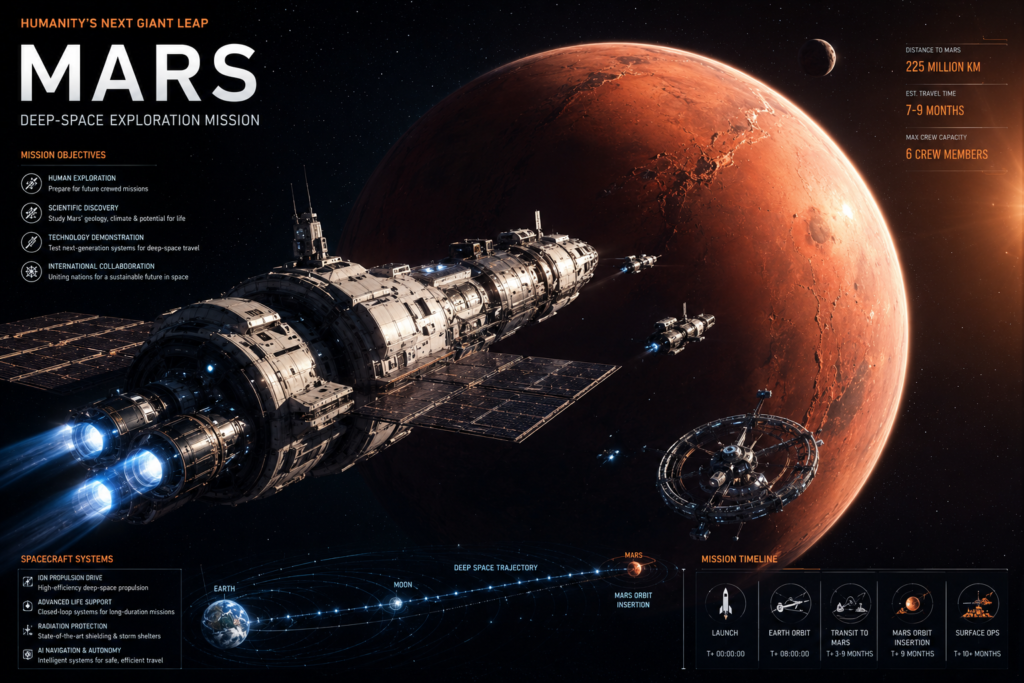
Mars Exploration Systems
Mars remains humanity’s most ambitious exploration target.
Future space technology developments are focused on:
- Habitat systems
- Life-support technologies
- Surface transportation
- Resource extraction
- Autonomous robotics
Space Manufacturing
Manufacturing products in microgravity may unlock entirely new industrial capabilities.
Researchers are exploring:
- Advanced semiconductors
- Fiber optics
- Pharmaceuticals
- Novel materials
Many experts view orbital manufacturing as a major commercial opportunity.
Space Tourism
What once seemed like science fiction is becoming reality.
Although still expensive, space tourism continues progressing toward broader accessibility through commercial spacecraft and reusable launch systems.
Quantum Communication Satellites
Quantum communication may redefine secure global networking.
Future satellite systems could enable virtually unhackable communications using quantum encryption technologies.
Space Exploration Technology and Its Impact on Daily Life
GPS and Navigation
Every time you use a smartphone navigation app, you’re benefiting from space exploration technology.
Satellite-based positioning supports:
- Transportation
- Logistics
- Ride-sharing
- Aviation
- Maritime operations
Weather Forecasting
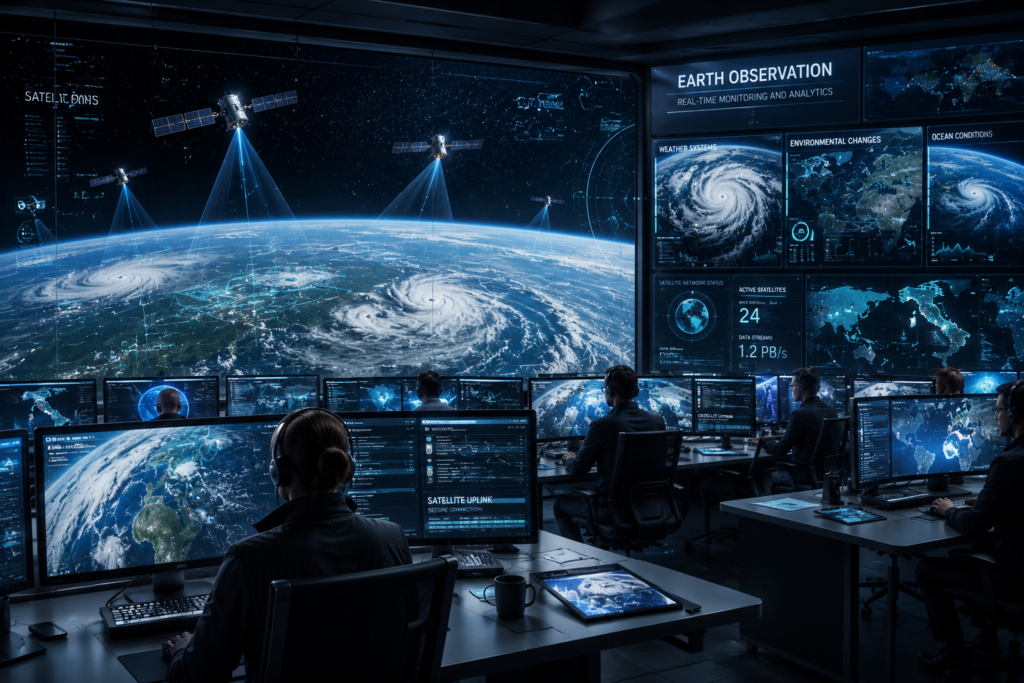
Modern weather prediction depends heavily on satellite observations.
Without satellite networks, forecasting hurricanes, storms, and droughts would be significantly less accurate.
Telecommunications
Global communications rely extensively on satellite infrastructure.
Video calls, broadcasting, internet services, and emergency communications all benefit from modern space technology.
Disaster Monitoring
Earth-observation satellites help governments monitor:
- Floods
- Wildfires
- Earthquakes
- Hurricanes
- Humanitarian crises
This capability saves lives and improves emergency response.
Climate Research
Climate scientists depend on space-based monitoring systems to track:
- Ice-sheet changes
- Ocean temperatures
- Deforestation
- Greenhouse gas emissions
Many of the most valuable environmental datasets originate from satellite platforms.
Aerospace Technology Trends Driving Innovation
AI-Powered Space Operations
AI is transforming mission planning and spacecraft management.
Future systems will increasingly perform:
- Autonomous navigation
- Predictive maintenance
- Real-time analytics
- Mission optimization
Digital Twins
Digital twin technology enables engineers to simulate spacecraft behavior before launch.
This approach reduces risk and improves mission reliability.
Robotics in Space
Space robotics is becoming essential for:
- Satellite servicing
- Lunar construction
- Maintenance operations
- Deep-space exploration
Additive Manufacturing
3D printing is changing aerospace engineering.
Future astronauts may manufacture spare parts directly on the Moon or Mars rather than waiting for Earth-based deliveries.
Sustainable Space Missions
Sustainability is becoming a major focus across all aerospace technology trends.
Key priorities include:
- Reusability
- Fuel efficiency
- Debris reduction
- Resource utilization
Comparison Table of Major Space Technologies
| Technology | Current Use | Future Potential | Commercial Impact | Adoption Timeline |
|---|---|---|---|---|
| Reusable Rockets | Satellite launches | Frequent low-cost access to space | Very High | Active Now |
| Satellite Internet | Global connectivity | Universal broadband coverage | Very High | 2026–2030 |
| Space Tourism | Limited commercial flights | Mainstream luxury travel | High | 2030–2040 |
| Lunar Infrastructure | Early development | Permanent lunar presence | Very High | 2028–2040 |
| AI Space Systems | Mission support | Fully autonomous missions | Extremely High | 2026–2035 |
| Autonomous Spacecraft | Limited autonomy | Deep-space exploration fleets | High | 2030–2040 |
Challenges Facing the Future of Space Technology
Space Debris
Orbital congestion continues growing.
Without effective debris management, collisions could threaten future missions and satellite networks.
Mission Costs
Although launch expenses have fallen dramatically, deep-space missions still require substantial investment.
Regulatory Issues
International cooperation remains essential.
Governments must address:
- Orbital traffic management
- Resource ownership
- Space governance
- Safety standards
Cybersecurity Risks
As spacecraft become more connected, cybersecurity becomes increasingly important.
Protecting critical satellite infrastructure will remain a major priority.
My Perspective After Following Space Innovation for 15 Years
Looking back, the most remarkable transformation has been the shift from government-led exploration to a mixed ecosystem of public and private innovation.
Fifteen years ago, reusable rockets were still largely experimental concepts. Today, they are reshaping launch economics.
What surprised me most was the speed at which AI entered aerospace operations. Initially, AI was viewed mainly as a support tool. Now, it is becoming central to autonomous mission planning, satellite management, and scientific discovery.
Another unexpected development has been the rapid commercialization of space infrastructure. Concepts such as orbital data centers, AI-enabled satellites, and in-space computing are moving from research papers to real-world planning. Recent initiatives envision massive space-based computing platforms capable of processing data directly in orbit. (Tom’s Hardware)
My prediction for the next decade is straightforward: the biggest breakthroughs will come from the intersection of AI, robotics, and space technology rather than from rockets alone.
The Future of Space Technology Beyond 2030
The future of space technology extends far beyond current missions.
Interplanetary Transportation
Advanced propulsion systems could make regular Mars missions feasible.
Space Mining
Asteroids contain valuable resources including rare metals and water that may support future space economies.
Orbital Manufacturing
Factories operating in microgravity could create products impossible to manufacture on Earth.
AI-Controlled Missions
Future spacecraft may independently navigate, repair themselves, and conduct scientific research with minimal human intervention.
Human Settlements Beyond Earth
The long-term vision includes permanent human communities on the Moon and eventually Mars.
NASA’s Artemis-related programs and lunar infrastructure initiatives demonstrate that foundational work toward this goal is already underway. (NASA)
Conclusion
The evolution of space technology is no longer a distant scientific story it is an economic, technological, and societal transformation happening right now.
The combination of reusable rockets, AI-driven operations, satellite mega-constellations, lunar infrastructure, autonomous spacecraft, and other latest space innovations is accelerating progress faster than any previous era of aerospace development.
For businesses, these developments create opportunities in communications, data analytics, logistics, manufacturing, cybersecurity, and emerging space services.
For individuals, space exploration technology continues improving navigation, connectivity, weather forecasting, disaster response, and environmental monitoring.
As future space technology advances toward lunar settlements, Mars missions, orbital manufacturing, and AI-controlled exploration systems, one thing is clear: the next decade will redefine humanity’s relationship with space, and those paying attention today will be best positioned to benefit from tomorrow’s opportunities.
Author

razamohd1203@gmail.com
Related Posts

Future Internet Trends You Should Know: Next Generation Internet Technologies Shaping 2026 and Beyond
- 0
- 1,779 word
Over the last 15 years, I have witnessed some of the most remarkable transformations in digital history. When I first started analyzing...
Future of Robotics in Daily Life: How Personal Robots Will Transform Homes and Society
- 0
- 1,859 word
The future of robotics is no longer a distant concept discussed only in research laboratories or science fiction movies. It is becoming...
AR vs VR: What’s the Difference Between Augmented Reality and Virtual Reality in 2026?
- 1
- 1,733 word
Imagine trying on a new pair of sunglasses without visiting a store or stepping inside a virtual classroom where you can walk...