
- 1
- 1,733 word
Imagine trying on a new pair of sunglasses without visiting a store or stepping inside a virtual classroom where you can walk around ancient Rome as if you were actually there. Both experiences are possible today thanks to immersive technologies, yet many people still struggle to understand the difference between them.
One of the questions I have heard repeatedly during technology conferences, product demonstrations, and enterprise innovation events over the last 15 years is: “What is the real difference between AR and VR?”
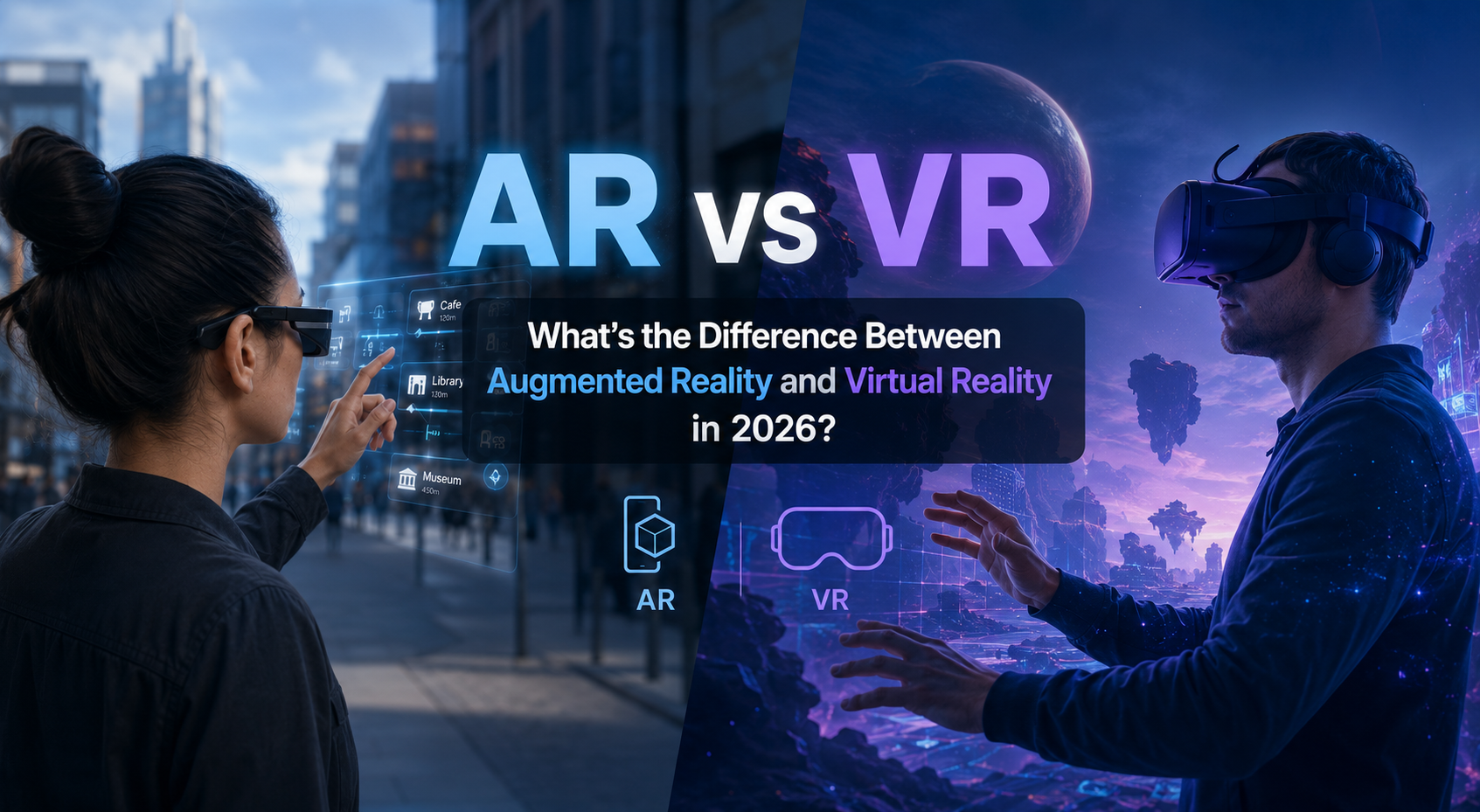
The confusion is understandable. Both technologies blend digital experiences with human interaction. Both are transforming industries. Both are becoming increasingly popular among businesses and consumers. However, the AR vs VR discussion is about two fundamentally different approaches to immersive computing.
Understanding augmented reality vs virtual reality matters more today than ever before. Companies are investing billions into spatial computing, smart glasses are becoming more practical, and virtual worlds are reshaping how people learn, work, shop, and play.
In this comprehensive guide, I will explain the difference between AR and VR, compare their strengths and limitations, and explore the rapidly expanding world of AR and VR applications that are shaping the future of technology.
What Is Augmented Reality (AR)?
Understanding AR in Simple Terms
Augmented Reality, commonly known as AR, enhances the real world by adding digital elements to it.
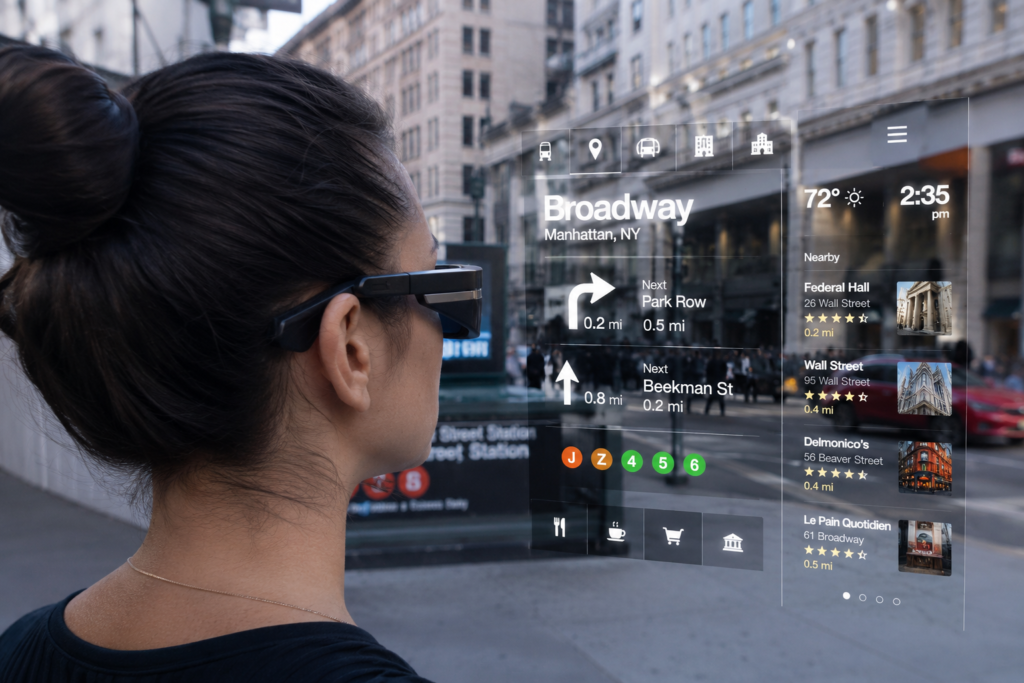
Instead of replacing reality, AR overlays computer-generated information, images, animations, or data onto your existing environment.
Think of AR as a digital layer placed on top of the real world.
One of the earliest examples that introduced AR to the mainstream was the video game Pokémon GO. Millions of people used their smartphones to see virtual characters appear in real-world locations.
Today, AR has evolved far beyond gaming.
During recent technology expos, I tested advanced AR smart glasses capable of displaying navigation directions, maintenance instructions, real-time language translation, and productivity tools directly within the user’s field of view.
The experience felt remarkably natural compared to the bulky prototypes I tested more than a decade ago.
How AR Works
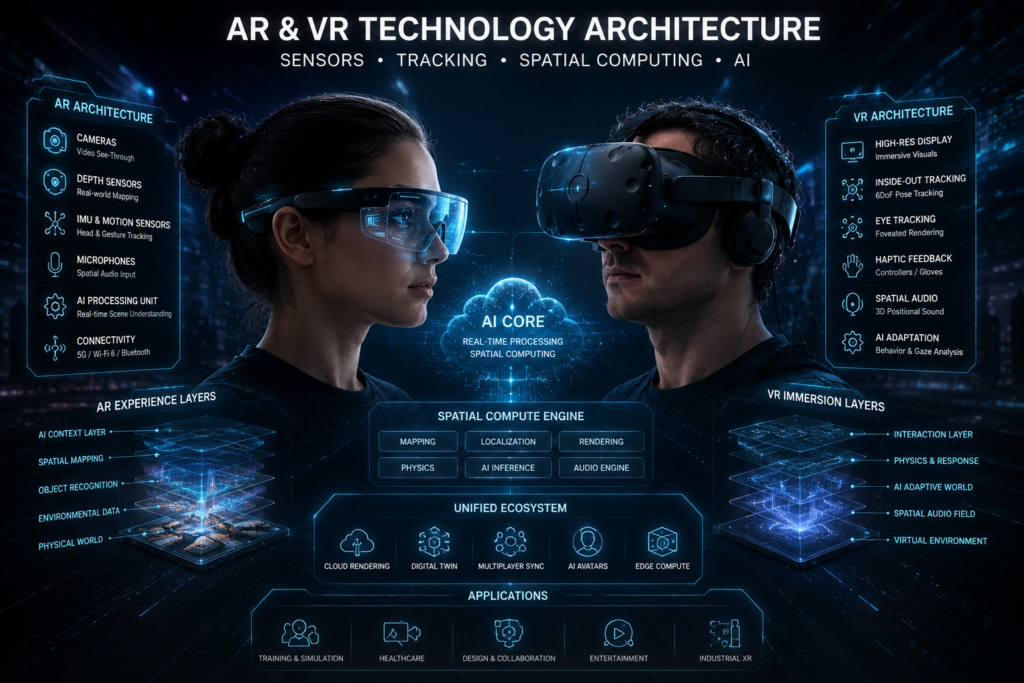
AR typically relies on:
- Cameras
- Sensors
- GPS
- Computer vision
- Artificial Intelligence
- Real-time rendering software
These technologies analyze the user’s environment and place digital content accurately within the real world.
Common AR Examples
- Mobile AR apps
- Smart glasses
- Interactive shopping experiences
- Navigation overlays
- Industrial maintenance systems
- Educational visualization tools
When comparing augmented reality vs virtual reality, AR always keeps users connected to their physical surroundings.
What Is Virtual Reality (VR)?
Understanding VR in Simple Terms
Virtual Reality takes a completely different approach.
Instead of enhancing reality, VR replaces it entirely.
When users put on a VR headset, they enter a fully digital environment that blocks out the physical world.
The goal is complete immersion.
I still remember testing some of the first consumer VR systems years ago. The technology was exciting, but the limited graphics, lower resolution displays, and tracking inaccuracies often broke immersion.
Modern VR headsets have changed dramatically.
Today’s systems feature:
- High-resolution displays
- Eye tracking
- Hand tracking
- Spatial audio
- Advanced motion sensors
- AI-powered interactions
These improvements create incredibly realistic experiences that feel much closer to reality.
How VR Works
VR combines:
- Specialized headsets
- Motion tracking systems
- Controllers
- 3D environments
- Real-time rendering engines
The technology continuously tracks user movements and updates the virtual world accordingly.
Common VR Examples
- Virtual gaming
- Flight simulators
- Medical training
- Virtual tourism
- Remote collaboration
- Military simulations
This is the key difference between AR and VR.
AR adds digital content to reality.
VR creates an entirely new reality.

AR vs VR Comparison
Key Differences at a Glance
| Feature | Augmented Reality (AR) | Virtual Reality (VR) |
|---|---|---|
| Environment | Real world enhanced with digital content | Completely virtual environment |
| Hardware Required | Smartphones, tablets, AR glasses | VR headset and controllers |
| User Experience | Mix of real and digital worlds | Fully immersive digital experience |
| Immersion Level | Moderate | High |
| Cost | Generally lower | Usually higher |
| Accessibility | More accessible | Requires dedicated equipment |
| Business Applications | Retail, logistics, maintenance | Training, design, simulation |
| Gaming Applications | Mobile and location-based games | Fully immersive gaming |
This AR vs VR comparison clearly shows that both technologies serve different purposes.
The difference between AR and VR is not about which one is better. It’s about which technology best solves a particular problem.
How AR and VR Technologies Work
Hardware Components
AR systems use:
- Cameras
- Smart glasses
- Mobile devices
- Depth sensors
- LiDAR systems
VR systems rely on:
- Head-mounted displays
- Motion controllers
- Eye tracking sensors
- Spatial audio systems
- Tracking cameras
Software Systems
Both AR and VR depend heavily on sophisticated software.
Core technologies include:
- 3D graphics engines
- Computer vision
- Spatial mapping
- Cloud computing
- Real-time rendering
Sensors and Tracking
Accurate tracking enables immersive experiences.
Devices use:
- Accelerometers
- Gyroscopes
- GPS
- LiDAR
- Infrared tracking
These sensors help systems understand user movements and environmental positioning.
AI Integration
Artificial Intelligence is becoming a major driver of immersive technology innovation.
AI enables:
- Intelligent virtual assistants
- Real-time translation
- Object recognition
- Personalized experiences
- Predictive interactions
The future of augmented reality vs virtual reality will be deeply connected to AI advancements.
Real-World AR and VR Applications
Gaming Industry
Gaming remains one of the largest categories of AR and VR applications.
AR gaming encourages exploration and physical movement.
VR gaming delivers complete immersion and realism.
Healthcare
Healthcare professionals use AR for surgical guidance and visualization.
VR helps train surgeons and supports therapy for anxiety, PTSD, and rehabilitation.
Education and Training
Students can explore historical events, scientific concepts, and complex environments through immersive learning experiences.
Training simulations reduce costs while improving safety and effectiveness.
Retail and E-Commerce
Retailers use AR to allow customers to preview products before purchasing.
Furniture visualization and virtual try-on experiences are becoming increasingly common.
Manufacturing
Manufacturers use AR overlays to guide workers through assembly and maintenance processes.
This improves efficiency and reduces errors.
Real Estate
Virtual property tours allow buyers to explore homes remotely.
AR helps visualize renovations and interior design changes.
Tourism and Entertainment
Museums, theme parks, and tourism companies increasingly rely on immersive technologies to engage visitors.
Throughout my career, I have consistently seen successful deployments focus on practical value rather than technological novelty.
Advantages of Augmented Reality
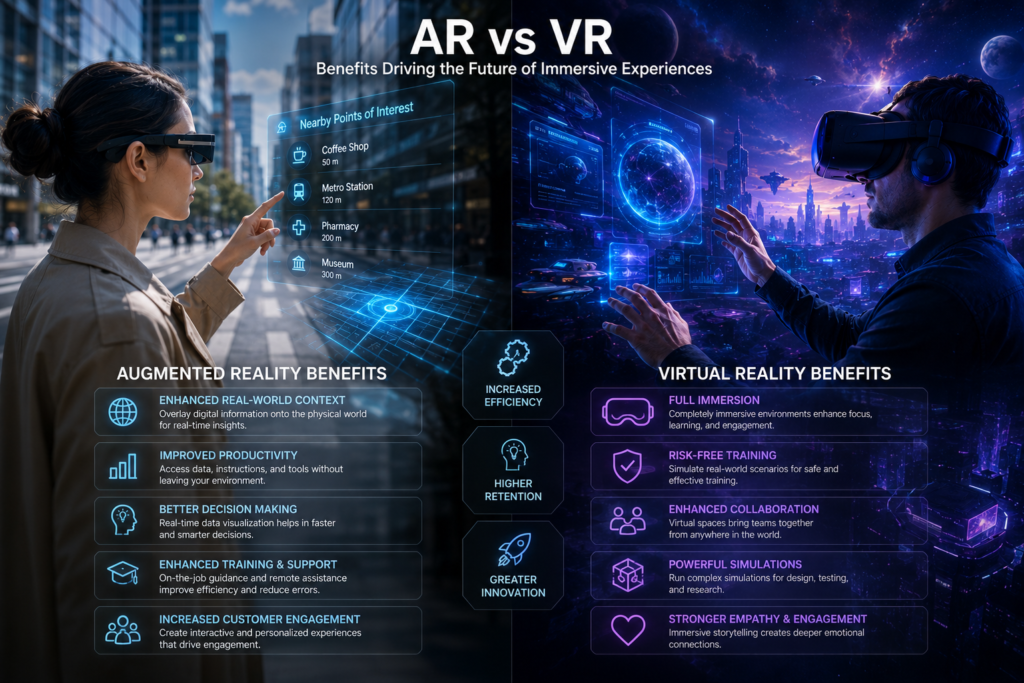
Improved User Engagement
AR creates highly interactive experiences that capture user attention and increase engagement.
Better Accessibility
Most smartphones already support AR functionality, making adoption easier.
Real-Time Information
AR delivers contextual information exactly when users need it.
Cost Efficiency
Many AR solutions can operate on existing consumer devices, reducing implementation costs.
Advantages of Virtual Reality
Full Immersion
VR creates a level of immersion unmatched by any other consumer technology.
Advanced Training Simulations
Organizations use VR to simulate dangerous, expensive, or complex scenarios safely.
Enhanced Learning Experiences
Immersive learning often improves retention and understanding.
Entertainment Innovation
VR continues to push the boundaries of gaming, storytelling, and digital experiences.
Challenges and Limitations of AR and VR
Hardware Costs
High-quality AR glasses and VR headsets remain expensive for many consumers.
Motion Sickness Issues
Some users experience dizziness or discomfort during prolonged VR sessions.
Privacy Concerns
AR devices collect significant amounts of environmental data, raising privacy questions.
Content Development Challenges
Creating immersive experiences requires specialized skills and substantial investment.
Adoption Barriers
Many organizations still struggle with implementation costs, training requirements, and infrastructure limitations.
Despite these challenges, the industry continues to mature rapidly.
Future of AR and VR Technologies
Spatial Computing
Spatial computing is transforming how humans interact with digital content.
Future systems will understand and respond to physical environments more naturally.
AI-Powered Experiences
AI will make immersive experiences more intelligent, adaptive, and personalized.
Mixed Reality Evolution
The boundaries between AR and VR will continue to blur.
Mixed Reality platforms will combine the best aspects of both technologies.
Enterprise Adoption
Businesses will increasingly use immersive solutions for collaboration, training, and productivity.
Consumer Trends
Smart glasses, lightweight headsets, and AI assistants will drive mainstream adoption.
The future of augmented reality vs virtual reality is not competition but convergence.
The next decade will bring entirely new categories of AR and VR applications that we can barely imagine today.
Which Is Better: AR or VR?
The answer depends on your goals.
Best for Businesses
AR often provides greater practical value because it integrates seamlessly into existing workflows.
Winner: AR
Best for Education
VR creates immersive learning environments that enhance engagement.
Winner: VR
Best for Gaming
VR offers unmatched immersion and realism.
Winner: VR
Best for Everyday Users
AR provides practical functionality without requiring dedicated hardware.
Winner: AR
Expert Opinion
After spending more than 15 years observing immersive technologies evolve, I believe AR will achieve broader adoption due to its everyday usefulness.
However, VR will remain the gold standard for immersive experiences.
The future belongs to both technologies working together.
Frequently Asked Questions
What is the difference between AR and VR?
AR enhances the real world with digital content, while VR replaces the real world with a virtual environment.
Is AR better than VR?
Neither is universally better. The ideal choice depends on the specific use case.
Can AR and VR work together?
Yes. Mixed Reality systems combine aspects of both technologies.
What are the most popular AR and VR applications?
Gaming, healthcare, education, manufacturing, retail, and real estate are among the most popular sectors.
Is VR more immersive than AR?
Yes. VR creates complete immersion by replacing the physical environment.
What industries use AR and VR?
Healthcare, education, retail, manufacturing, entertainment, construction, defense, and real estate.
Will AR replace smartphones?
AR smart glasses may reduce smartphone dependence, but complete replacement is unlikely in the near future.
What is the future of AR and VR?
The future involves AI-powered experiences, spatial computing, mixed reality, and widespread enterprise adoption.
1 comment
Leave a Reply
Author

razamohd1203@gmail.com
Related Posts

Space Technology in 2026: How Future Space Technology is Transforming Exploration and Innovation
- 0
- 1,598 word
Fifteen years ago, when I first began closely following the aerospace sector, space missions were largely dominated by government agencies, long development...

Future Internet Trends You Should Know: Next Generation Internet Technologies Shaping 2026 and Beyond
- 0
- 1,779 word
Over the last 15 years, I have witnessed some of the most remarkable transformations in digital history. When I first started analyzing...

Future of Robotics in Daily Life: How Personal Robots Will Transform Homes and Society
- 0
- 1,859 word
The future of robotics is no longer a distant concept discussed only in research laboratories or science fiction movies. It is becoming...
https://shorturl.fm/gK2A6