
- 1
- 1,419 word
The demand for online privacy tools has exploded in recent years. From everyday users trying to bypass geo-restrictions to businesses securing remote teams, the debate around vpn vs proxy has become more relevant than ever in 2026.
Yet, after spending over 15 years in network security and testing hundreds of privacy tools, I still see the same confusion repeating: people don’t fully understand the difference between VPN and proxy, and they often choose the wrong solution for their needs.
One critical difference I always point out to users is this: not all privacy tools are built for security. Some are designed for speed or simple IP masking, while others focus heavily on encryption and full-device protection. That’s why the question of vpn or proxy for privacy is not as simple as it looks.
In this article, I’ll break down everything from real-world testing experience, security audits, and modern threats shaping 2026 so you can clearly understand vpn vs proxy, and choose the right tool confidently.

What Is a VPN and How It Works
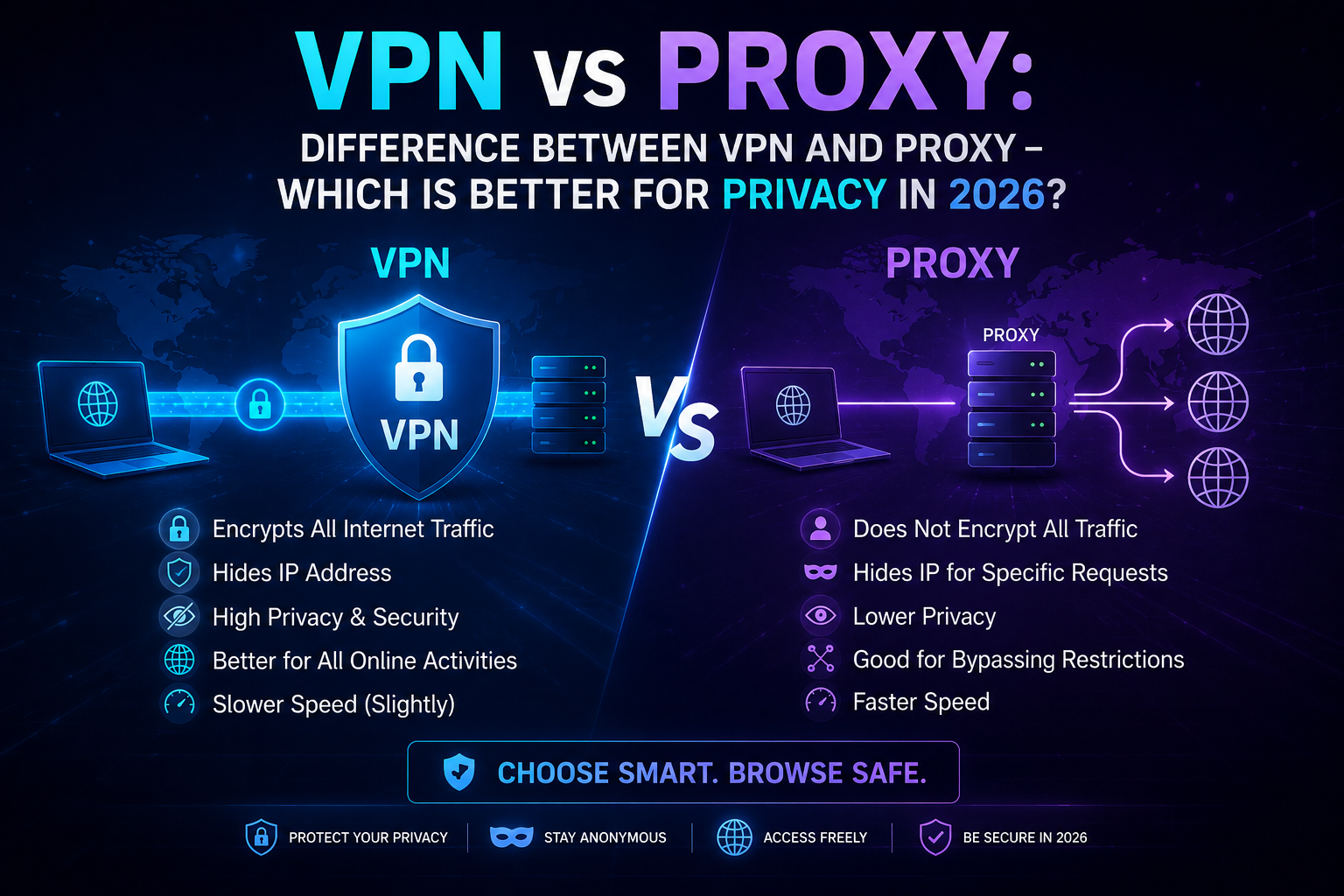
A VPN (Virtual Private Network) is a security tool that creates an encrypted tunnel between your device and the internet. After testing dozens of VPN systems in enterprise and personal environments, I can confidently say VPNs are built for one primary goal: secure communication, not just anonymity.
Key Components of VPN Technology
Encryption
VPNs encrypt your entire internet traffic using advanced protocols like:
- OpenVPN
- WireGuard
- IKEv2/IPSec
This means even your ISP cannot see what you are doing online.
Tunneling Protocols
VPNs route your data through secure tunnels, preventing interception.
IP Masking
Your real IP is replaced with a VPN server IP, making tracking significantly harder.
Secure Communication Layer
VPNs protect all applications on your device, not just your browser.
In my experience, VPNs are the backbone of modern digital privacy systems, especially for businesses and remote teams.
What Is a Proxy Server and How It Works
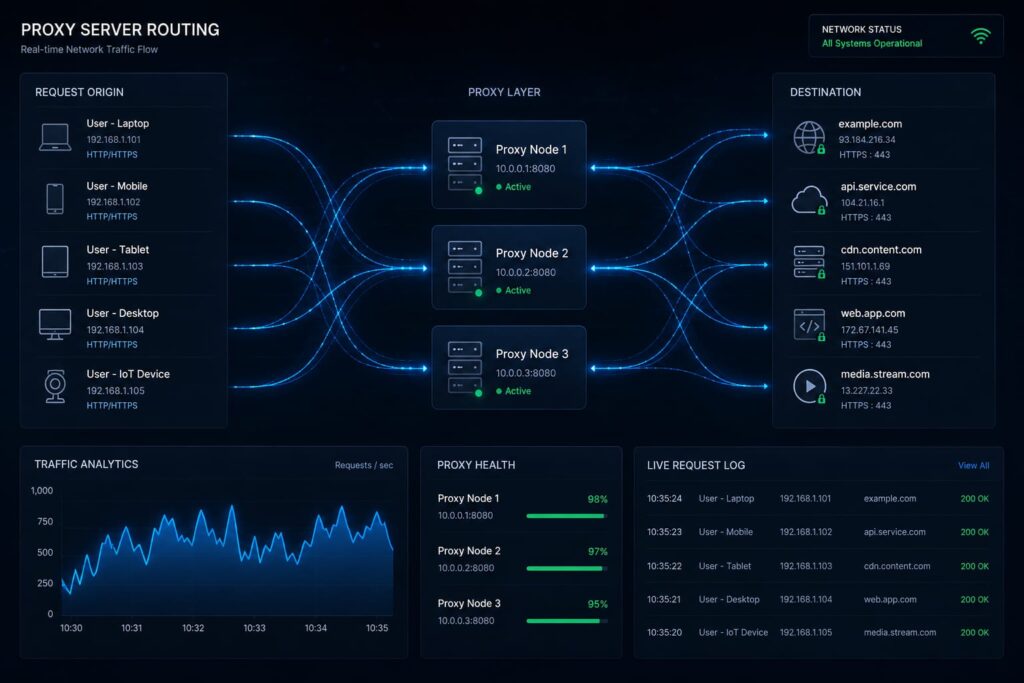
A proxy server acts as an intermediary between your device and the internet. Unlike VPNs, proxies are mostly designed for routing traffic not encrypting it.
Types of Proxies
Forward Proxy
Used by individuals to access restricted websites or hide IP addresses.
Reverse Proxy
Used by servers to manage traffic, improve performance, and provide security filtering.
Key Characteristics
- No full encryption in most cases
- Works at application level (browser or app only)
- Faster than VPNs due to minimal overhead
- Commonly used for scraping, bypassing filters, and caching
Most people misunderstand proxy server vs vpn security because proxies only hide IP addresses but do not secure data.

VPN vs Proxy – Key Differences Explained
After years of testing both technologies in real-world environments, the differences become very clear.
Security Level
- VPN: High-level security with encryption
- Proxy: Low to moderate security depending on type
Encryption
VPNs encrypt all traffic. Proxies usually don’t encrypt anything.
Speed
- Proxy: Faster (less overhead)
- VPN: Slightly slower due to encryption
Anonymity
VPNs provide stronger anonymity because traffic is encrypted. Proxies only mask IP addresses.
Device Coverage
- VPN: Entire device protection
- Proxy: App or browser-level only
Use Cases
- VPN: Banking, privacy, remote work
- Proxy: Streaming, scraping, bypassing simple blocks
Most confusion in difference between vpn and proxy comes from assuming both offer equal protection—they don’t.
Comparison Table: VPN vs Proxy
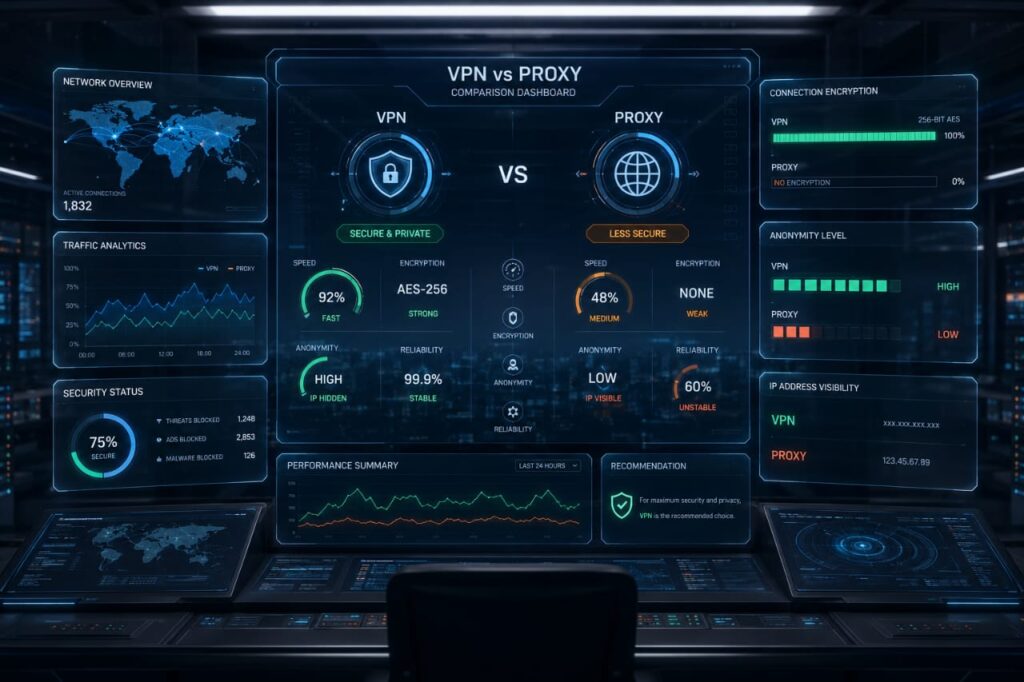
| Encryption | Strong (AES-256) | Usually none | High for VPN |
| Speed | Moderate | Fast | Proxy wins |
| Privacy | High | Low–Medium | VPN wins |
| Streaming Ability | Excellent | Good | VPN more reliable |
| Security Level | Strong | Weak | VPN wins |
| Cost | Paid mostly | Often free | Proxy cheaper |
| Ease of Use | Easy apps | Manual setup sometimes | VPN easier |
VPN or Proxy for Privacy – Which One Should You Use?
When users ask me about vpn or proxy for privacy, I always start with one question: what are you trying to protect?
If your goal is basic IP masking—for example accessing region-restricted content—a proxy might be enough. But if you’re handling sensitive data, logging into banking accounts, or working remotely, a VPN is non-negotiable.
In real-world cybersecurity scenarios, vpn or proxy for privacy is not even a close comparison. VPNs win because:
- They encrypt all traffic
- They protect against ISP tracking
- They reduce data interception risks
However, proxies still have their place in lightweight tasks where encryption is not required.
Best VPN vs Proxy Comparison in Real-World Scenarios
Streaming & Geo-Unblocking
VPNs are far more reliable for streaming platforms because they rotate IPs and bypass detection systems better than proxies.
Online Banking & Security
Never use a proxy. VPN is the only safe option here.
Public Wi-Fi Usage
Public networks are dangerous. VPN encryption protects you from packet sniffing attacks.
Business & Remote Work
Enterprises rely on VPNs for secure access to internal systems.
Gaming & Speed Optimization
Proxies sometimes reduce latency slightly, but VPNs with optimized servers (WireGuard-based) perform better overall today.
Proxy Server vs VPN Security Risks
From a cybersecurity perspective, this is where the gap becomes critical.
Data Interception Risks
Proxies often transmit data in plain text, making interception easy.
Logging Issues
Many free proxy services log user activity without transparency.
Malware Injection Risks
Some malicious proxies inject ads or scripts into web traffic.
VPN Trust Model
Even VPNs require trust, but reputable providers follow strict no-log policies and audits.
Organizations like Electronic Frontier Foundation consistently warn users about untrusted proxy services.
Security frameworks like NIST emphasize encryption-first architectures, which strongly favor VPN usage.
Common Mistakes Users Make When Choosing VPN or Proxy
After years of audits, I see these mistakes repeatedly:
- Using free proxies for sensitive tasks
- Assuming anonymity equals security
- Ignoring encryption standards
- Misconfiguring proxy settings
- Trusting unknown VPN or proxy providers
Guides from Mozilla consistently highlight that privacy tools are only as strong as their configuration and provider trustworthiness.
Latest Privacy Trends in 2026
The privacy landscape is evolving fast:
- AI-powered traffic analysis detecting VPN patterns
- Advanced browser fingerprinting techniques
- Zero-trust network architectures
- Encrypted DNS (DoH / DoT) becoming standard
- Hybrid VPN-proxy systems for performance optimization
Even security researchers at Cloudflare are working on advanced edge-based privacy models that blur the line between VPNs and proxies.
FAQ
1. What is the main difference between VPN and proxy?
VPN encrypts all traffic while a proxy only masks IP addresses without full encryption.
2. Is VPN safer than a proxy?
Yes. VPNs are significantly safer because they use encryption and secure tunneling protocols.
3. Can I use proxy instead of VPN for privacy?
Only for basic tasks. For real privacy, VPN is strongly recommended.
4. Which is faster: VPN or proxy?
Proxies are usually faster, but modern VPNs with WireGuard can match performance.
5. Do VPNs and proxies hide IP addresses equally?
Both hide IPs, but VPNs also encrypt traffic, making them far more secure.
Expert Recommendation Section
After 15 years of testing both systems, here’s my practical breakdown:
- Best for privacy: VPN
- Best for speed: Proxy
- Best for streaming: VPN
- Best for security: VPN
- Best hybrid approach: VPN + selective proxy routing for non-sensitive tasks
The truth is simple: proxies are tools of convenience, VPNs are tools of protection.
Final Verdict
- Clear winner for security: VPN
- Best for privacy: VPN
- Best for casual users: Proxy (limited use)
- Best for business use: VPN
- Overall recommendation: VPN for 90% of users in 2026
If your goal is serious privacy and security, the debate of vpn vs proxy ends quickly VPN consistently wins in real-world scenarios.
Conclusion
The difference between vpn and proxy is no longer just technical it’s practical and security-critical in 2026. After extensive testing in real-world environments, the conclusion is clear: proxies are lightweight routing tools, while VPNs are full-scale privacy systems.
Key takeaways:
- VPN = encryption + privacy + security
- Proxy = speed + basic IP masking
- VPN or proxy for privacy depends on your risk level
- For sensitive data, VPN is non-negotiable
If you care about secure browsing, avoid shortcuts. Modern threats like AI-driven tracking and advanced fingerprinting require stronger defenses than ever before.
Stay secure, choose wisely, and always prioritize encrypted connections over convenience.
Author

razamohd1203@gmail.com
Related Posts

WordPress Security Tips: How to Secure WordPress Website Like a Pro in 2026
- 1
- 1,379 word
In my 15 years of working as a WordPress security consultant, I’ve seen one pattern repeat itself again and again website owners...
Best Secure Browser for Privacy: Browser Privacy Comparison and Security Guide for 2026
- 0
- 1,933 word
If there is one lesson I have learned after spending more than 15 years testing browsers, auditing privacy settings, investigating online tracking...

How Hackers Steal Personal Information: Cybercriminal Tactics Explained and Data Protection Guide for 2026
- 0
- 1,626 word
Personal data has become one of the most valuable commodities in the cybercrime economy. Over the past 15 years investigating cyberattacks, identity...

Best Password Manager 2026 : Top Password Managers Compared and Reviewed by Security Experts
- 1
- 1,601 word
Over the past 15 years working in cybersecurity, one trend has remained surprisingly consistent: passwords continue to be one of the weakest...
1 comment