

- 3
- 1,809 word
In 2026, businesses are no longer asking whether they should adopt AI. The real question is how fast they can implement it before competitors automate faster, scale smarter, and reduce operational costs more efficiently.
Over the last few years, I’ve worked with startups, eCommerce stores, SaaS platforms, agencies, and online businesses implementing AI automation for businesses across customer support, lead generation, CRM workflows, marketing campaigns, analytics, and operational systems. One thing became obvious very quickly: companies using AI strategically are operating with significantly leaner teams while producing faster results.
What surprised me most wasn’t just productivity gains. It was how artificial intelligence in business operations changed decision-making itself. Businesses now predict customer behavior, automate reporting, personalize user experiences, and optimize workflows in ways that previously required large teams and enterprise budgets.
In my experience implementing AI automation for businesses, the companies seeing the best results are not replacing humans entirely. Instead, they are removing repetitive work so teams can focus on strategy, creativity, and growth.
Why AI Automation for Businesses Is Growing Rapidly
Rising Operational Costs
Hiring, training, and scaling teams has become increasingly expensive. Businesses are now using ai workflow automation software to reduce repetitive manual work such as:
- Customer onboarding
- Data entry
- Reporting
- Social media scheduling
- CRM updates
- Email follow-ups
A small business that once needed three support agents can now operate with one trained manager overseeing AI-powered systems.
Demand for Faster Workflows
Customers expect instant responses, personalized recommendations, and faster services. AI business automation tools help companies meet those expectations 24/7.
For example, AI chatbots now handle:
- Order tracking
- Appointment scheduling
- Product recommendations
- FAQ support
- Lead qualification
The speed difference alone often improves customer retention.
AI-Driven Customer Expectations
Consumers already interact with AI daily through search engines, recommendation systems, and virtual assistants. Businesses failing to modernize their operations often feel outdated compared to competitors using AI-powered experiences.
Productivity & Cost Reduction
One hidden limitation I noticed while automating workflows is that many companies initially overcomplicate automation. The best AI systems are usually simple:
- Automate repetitive tasks first
- Improve reporting second
- Enhance customer experience third
Businesses trying to automate everything immediately often create operational confusion.
How AI is Changing Business Operations
AI in Customer Support
AI-powered support systems have evolved dramatically in 2026.
Modern chatbots understand context, customer history, and purchasing behavior. Instead of scripted responses, businesses now use conversational AI systems trained on internal documentation and support tickets.
After testing several ai business automation tools, I found that businesses save the most time when AI handles first-level support while humans manage complex cases.
Benefits include:
- 24/7 support
- Faster response times
- Reduced support costs
- Better ticket prioritization
- Multilingual customer service

AI in Marketing Automation
Marketing automation has become one of the most valuable AI applications.
AI tools now optimize:
- Email subject lines
- Ad targeting
- SEO recommendations
- Content generation
- Customer segmentation
- Social media scheduling
AI-powered marketing workflows analyze campaign performance in real time and adjust strategies automatically.
For WordPress businesses and SaaS startups, this dramatically improves scalability.
AI in HR & Recruitment
Recruitment automation is becoming increasingly common.
AI systems now:
- Screen resumes
- Rank applicants
- Schedule interviews
- Generate onboarding workflows
- Analyze employee engagement
However, companies still need human oversight to avoid hiring bias and poor cultural matching.
AI in Sales Pipelines
Sales automation has become incredibly sophisticated.
CRM systems now predict:
- High-converting leads
- Churn probability
- Upselling opportunities
- Follow-up timing
Tools integrated with AI workflow automation software help sales teams prioritize leads more effectively.
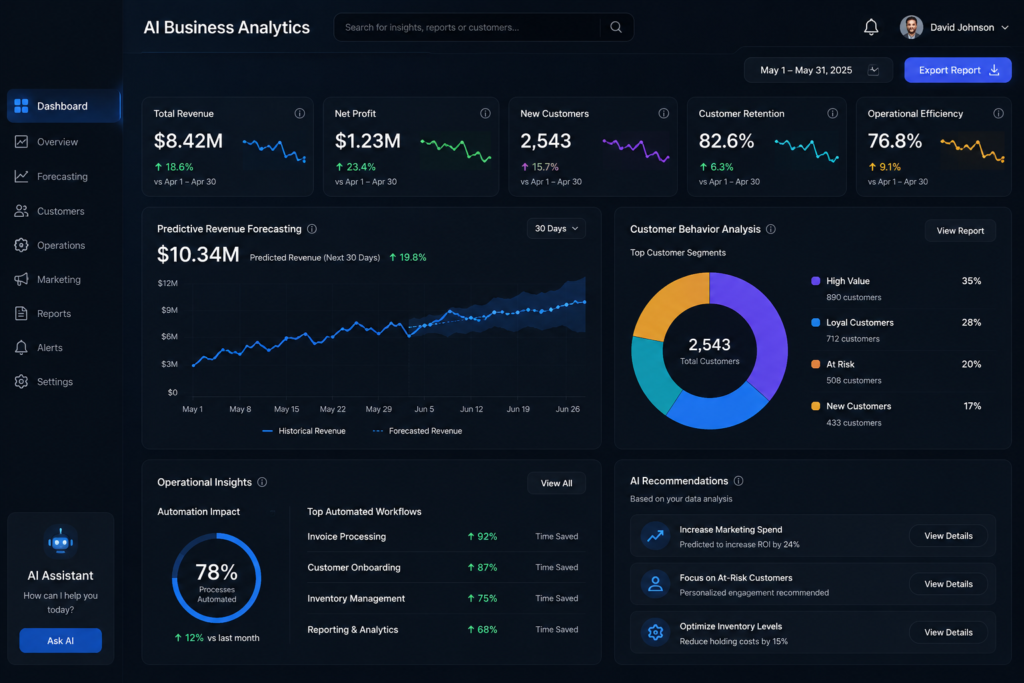
AI in Data Analytics
Business analytics used to require analysts manually building dashboards and reports.
Today, AI systems generate:
- Revenue forecasts
- Trend analysis
- Automated summaries
- Customer behavior predictions
This has fundamentally changed how ai is changing business decision-making.
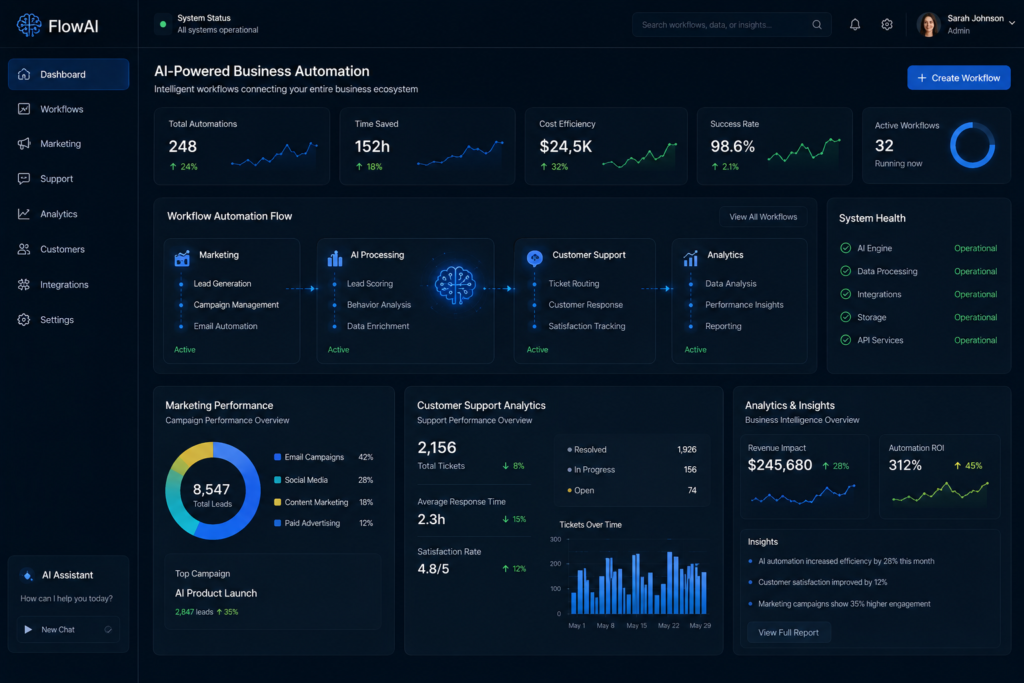
Best AI Business Automation Tools in 2026
OpenAI ChatGPT
Best for:
- Content creation
- Customer support
- Internal knowledge systems
- Workflow assistance
In my experience, ChatGPT works exceptionally well when connected with CRM systems and automation platforms.
Hidden limitation:
AI hallucinations still happen if businesses rely on unverified outputs.
Official platform: OpenAI
Anthropic Claude
Best for:
- Long-form document analysis
- Research workflows
- Internal operations
Claude performs particularly well with lengthy business documentation.
Official platform: Anthropic Claude
Google Gemini
Best for:
- Google Workspace integration
- Productivity workflows
- Search-based AI assistance
Businesses already using Google ecosystems benefit significantly.
Official platform: Google Gemini
Zapier Zapier AI
Best for:
- Workflow automation
- SaaS integrations
- No-code automation
While scaling online business operations, Zapier became one of the fastest ways to automate repetitive tasks between platforms.
Official platform: Zapier AI Automation
HubSpot HubSpot AI
Best for:
- CRM automation
- Lead nurturing
- Email automation
HubSpot is extremely effective for agencies and B2B companies.
Official platform: HubSpot AI Tools
Notion Notion AI
Best for:
- Team productivity
- Documentation
- AI-powered notes
Great for startups managing internal workflows.
Official platform: Notion AI
Salesforce Salesforce Einstein
Best for:
- Enterprise CRM
- Predictive sales
- AI forecasting
One of the strongest enterprise-grade AI systems currently available.
Official platform: Salesforce Einstein
Microsoft Microsoft Copilot
Best for:
- Office productivity
- Enterprise automation
- Internal documentation
Especially useful for businesses deeply integrated into Microsoft ecosystems.
Official platform: Microsoft AI Solutions
Jasper Jasper AI
Best for:
- Marketing teams
- SEO workflows
- Brand content generation
Excellent for scaling content production.
Official platform: Jasper AI
AI Workflow Automation Software: Real-World Business Use Cases
Automating Repetitive Tasks
The fastest ROI usually comes from automating repetitive operational tasks.
Examples include:
- Invoice generation
- CRM updates
- Appointment reminders
- Inventory syncing
- Data exports
AI Email Automation
AI email systems now:
- Personalize campaigns
- Predict open rates
- Optimize send times
- Generate sequences automatically
Businesses using AI-powered email systems often improve conversions significantly.
AI Content Workflows
Content marketing teams now use AI for:
- SEO briefs
- Content outlines
- Video scripts
- Product descriptions
- Social media captions
However, human editing remains critical for originality and brand voice.
AI-Powered CRM Systems
CRM automation has become one of the strongest examples of artificial intelligence in business operations.
Modern systems automatically:
- Score leads
- Track behavior
- Predict sales outcomes
- Trigger automation flows
AI Project Management
Project management tools now estimate deadlines, identify bottlenecks, and summarize meetings automatically.
Artificial Intelligence in Business Operations: Hidden Benefits Most Companies Ignore
Many businesses focus only on cost reduction, but the biggest AI advantage is operational clarity.
Time Savings
Teams spend less time on repetitive admin work.
Reduced Human Errors
Automation minimizes manual mistakes in:
- Reporting
- CRM data
- Scheduling
- Inventory systems
Faster Reporting
AI dashboards generate instant business summaries instead of requiring hours of manual analysis.
Smarter Decision-Making
AI-powered analytics help businesses identify:
- Market trends
- Customer behavior shifts
- Revenue opportunities
Predictive Analytics
Predictive systems now forecast:
- Sales patterns
- Customer churn
- Product demand
Customer Personalization
AI-driven personalization improves:
- Recommendations
- Marketing emails
- Shopping experiences
Workflow Scalability
Automation allows businesses to scale without proportionally increasing staff size.
AI-Powered Forecasting
Forecasting tools help businesses reduce waste and optimize operational planning.
AI Automation for Businesses: Hidden Challenges & Risks
Data Privacy Concerns
Businesses handling sensitive data must carefully manage AI integrations and compliance requirements.
AI Hallucination Risks
AI-generated misinformation remains a serious concern, especially in customer-facing systems.
Automation Dependency
Over-automation can reduce flexibility and create operational vulnerabilities.
Employee Training Challenges
Teams often struggle adapting to new AI workflows initially.
AI Security Issues
AI-powered systems can introduce cybersecurity risks if businesses fail to secure integrations properly.
Balanced implementation matters more than aggressive automation.
Comparison Table: Best AI Business Automation Platforms
| AI Tool | Best For | Automation Features | Ease of Use | Pricing | Integration Support | Business Type |
|---|---|---|---|---|---|---|
| ChatGPT | Content & support | AI chat, writing, automation | Easy | Flexible | Strong | Startups & agencies |
| Claude | Research workflows | Document analysis | Easy | Mid-range | Moderate | SaaS & enterprise |
| Gemini | Productivity | Workspace AI automation | Easy | Flexible | Excellent | Google-based businesses |
| Zapier AI | Workflow automation | App integrations | Very Easy | Scalable | Excellent | All business sizes |
| HubSpot AI | CRM & marketing | Lead nurturing | Moderate | Higher | Excellent | B2B companies |
| Salesforce Einstein | Enterprise CRM | Predictive analytics | Advanced | Premium | Enterprise-grade | Large enterprises |
| Microsoft Copilot | Office workflows | Productivity AI | Easy | Subscription | Excellent | Corporate teams |
| Jasper AI | Marketing content | AI content workflows | Easy | Moderate | Strong | Marketing agencies |
How Small Businesses Can Use AI Workflow Automation Software
AI for Startups
Startups can automate:
- Customer onboarding
- Marketing campaigns
- Internal documentation
AI for Freelancers
Freelancers benefit from:
- AI scheduling
- Proposal generation
- Invoice automation
AI for Agencies
Agencies can scale faster using:
- AI reporting
- Client dashboards
- Content workflows
AI for eCommerce Stores
eCommerce businesses now automate:
- Product recommendations
- Inventory updates
- Customer support
- Email marketing

Frequently Asked Questions
What is ai automation for businesses?
AI automation for businesses refers to using artificial intelligence systems to automate repetitive tasks, workflows, customer interactions, analytics, and operational processes.
How ai is changing business operations in 2026?
AI is changing business through automation, predictive analytics, smarter customer experiences, workflow optimization, and AI-powered decision-making systems.
What are the best ai business automation tools?
Popular ai business automation tools include ChatGPT, Zapier AI, HubSpot AI, Salesforce Einstein, Claude, Gemini, and Microsoft Copilot.
Which ai workflow automation software is best for small businesses?
For small businesses, tools like Zapier AI, HubSpot AI, Notion AI, and ChatGPT provide excellent automation flexibility without requiring large enterprise budgets.
How is artificial intelligence in business operations improving productivity?
Artificial intelligence in business operations improves productivity by reducing repetitive work, automating reporting, optimizing workflows, and enabling faster decision-making.
Conclusion
AI automation is no longer optional for modern businesses. It has become one of the biggest competitive advantages in 2026.
In my experience implementing AI automation for businesses, the companies achieving the best results are not necessarily the ones using the most advanced AI systems. They are the ones strategically automating repetitive work while keeping human creativity, leadership, and customer relationships at the center.
For small businesses and freelancers, lightweight AI workflow automation software like Zapier AI, ChatGPT, and Notion AI can dramatically improve productivity without massive investment.
For agencies and SaaS companies, CRM automation, AI analytics, and workflow integrations create operational scalability that was difficult to achieve just a few years ago.
Large enterprises benefit most from predictive analytics, enterprise AI systems, and advanced operational forecasting tools.
The future of artificial intelligence in business operations is not about replacing humans entirely. It is about building smarter, faster, and more adaptive organizations that can scale efficiently while delivering better customer experiences.
Businesses that start learning and implementing AI today will likely have a major operational advantage over slower competitors throughout the rest of the decade.
Author

razamohd1203@gmail.com
Related Posts
Best AI Apps for iPhone in 2026: Top AI Assistants, Productivity & Automation Apps
- 0
- 1,701 word
Artificial intelligence has completely transformed the way we use our iPhones. What started with simple voice commands has evolved into powerful AI...
AI Tools for Teachers: 10 Smart Platforms Transforming Education in 2026
- 0
- 1,785 word
Artificial intelligence has moved far beyond being a futuristic concept in education. Over the past decade and a half, I have worked...
AI Voice Cloning Software 2026: My Real-World Tests Revealed the Most Human-Sounding AI Voices
- 0
- 1,458 word
Twenty-five years ago, creating a professional voice-over required a recording studio, expensive microphones, skilled voice actors, and hours of editing. Today, a...

Future of Artificial Intelligence: How AI Will Change Everyday Life in 2026
- 2
- 1,412 word
The future of artificial intelligence is no longer a distant concept I used to write about a decade ago as “coming soon.”...

Free AI Video Generator for YouTube Creators: Best Tools 2026
- 0
- 1,395 word
The way YouTube content is created has completely changed in the last few years. What used to take hours of scripting, filming,...

Best AI Productivity Apps for Remote Work in 2026 – Tools That Actually Save Time
- 3
- 1,903 word
Remote work has evolved from a temporary trend into a permanent business model. Over the last decade, I’ve worked with distributed teams...
3 comments